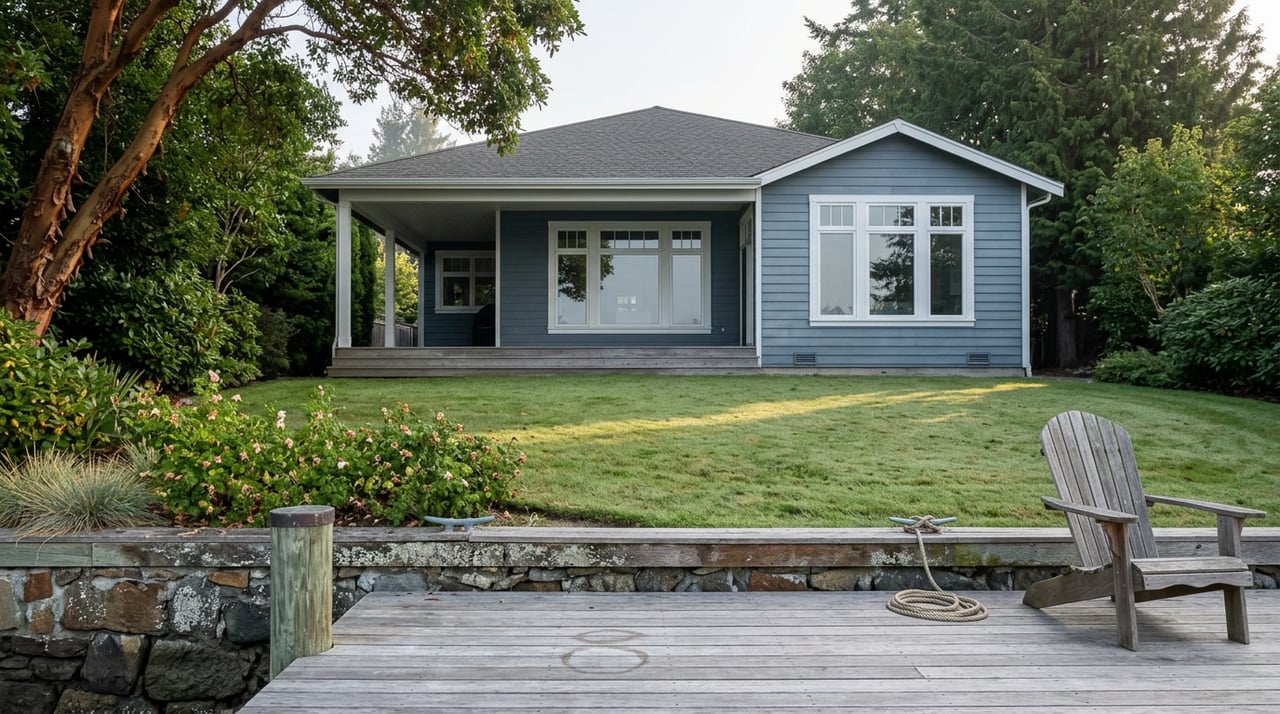
Two waterfront listings go live in the same week, both in protected coves near Wollochet Bay, both mid-century homes updated within the last decade, both priced within twenty thousand dollars of each other. One goes pending in eleven days. The other sits through a price reduction, a buyer who walks after inspection, and a second round of showings before it finally closes six weeks later than the seller expected.
The house that moved faster wasn't staged better. It had a folder.
Inside it: the original dock permit, a marine contractor's maintenance log, and a letter confirming the moorage sat entirely on the owner's own tidelands rather than crossing into state-owned aquatic land. The slower sale had none of that on hand, and the buyer's lender wanted answers before it wanted a signature.
That gap is the thesis of this piece. On Gig Harbor waterfront, the paperwork behind the dock and bulkhead moves on its own clock, one that has nothing to do with how hot or soft the broader market feels that month. A seller who treats price as the only lever is negotiating with one hand tied behind their back.
The permit stack nobody mentions at the listing appointment
A typical inland listing in Gig Harbor answers to one jurisdiction: the county or city building department. A waterfront listing answers to several, and each one has its own definition of what counts as work, what counts as an exemption, and how long review takes.
Pierce County reviews shoreline substantial development under its own shoreline code. The Washington Department of Fish and Wildlife reviews anything that touches the bed or flow of state waters through a Hydraulic Project Approval. If any part of the dock or float crosses state-owned tidelands, the Washington Department of Natural Resources gets involved through an aquatic lands lease. If the work touches navigable water or involves dredge and fill, the U.S. Army Corps of Engineers joins the file too.
None of these agencies coordinate a shared deadline. That's the friction most sellers discover only after they've already accepted an offer.
| Agency | What it governs | Typical timeline |
|---|---|---|
| Pierce County (Shoreline permit / SEPA) | New or replacement bulkheads and most shoreline structures | Full review required once cost exceeds the fair market value exemption; bulkheads over 4 feet in height also trigger a building permit and environmental review |
| WDFW (Hydraulic Project Approval) | Docks, floats, piling, and bulkheads that touch state waters | Up to 45 days once the application is complete |
| DNR (Aquatic lands lease) | Structures crossing state-owned tidelands | 6 to 12 months from a complete application; transfer to a new owner requires state approval |
| U.S. Army Corps of Engineers | Federal review of work in navigable waters | Runs in parallel with state and county review |
The line most sellers don't notice until they're over it
Pierce County exempts small shoreline projects from a full Shoreline Substantial Development Permit, but the exemption only applies below a fair market value threshold of $7,047. Most real dock repair or bulkhead work costs more than that once materials, permitting, and marine labor are counted, which means the exemption rarely covers anything beyond the smallest cosmetic fix.
Height adds a second trigger. A bulkhead measured at more than 4 feet from finished grade, counting anything buried below ground, requires both a building permit and environmental review under the State Environmental Policy Act, on top of shoreline approval. The county's own guidance is direct on the purpose behind this: a normal protective bulkhead exists to guard an existing home from erosion, not to manufacture new dry land, and any project built for the latter purpose won't qualify for the lighter review track.
Sellers who assume "it's just a repair" often find their contractor's invoice puts the project well past both thresholds, which means the permit history matters even when no new work is planned before closing. Buyers and their lenders are asking about that history now, not just about future construction.
What an incomplete file actually costs you
Working on a dock or bulkhead without an HPA isn't a paperwork technicality. WDFW can pursue a civil penalty of up to $10,000 per violation, and repeat or serious violations can carry criminal exposure. A buyer's attorney or lender who spots gaps in that history has reason to slow down, not speed up.
The DNR lease adds a second wrinkle that surprises more people than it should. If part of the moorage sits on state-owned tidelands, the existing lease does not transfer to a new owner automatically. Transfer requires state approval, and the specific terms of the lease can add conditions of their own. A buyer can close on the house and still be waiting on the state before the dock is fully theirs to use the way the listing photos suggested.
Flood zone status rides along quietly in the same file. Pierce County participates in FEMA's floodplain mapping program, and a parcel inside a special flood hazard zone can affect both insurance cost and what kind of shoreline armoring is even allowed if a bulkhead ever needs replacing. Buyers ask about this earlier than sellers expect, usually the moment their lender pulls the flood determination.
Waterfront permits don't run on the housing market's calendar. A dock file started the week a home goes live may not clear WDFW until well into fall, and a DNR lease question opened today can still be open when the next selling season begins.
A sequence that gets ahead of the clock
- Request the county's shoreline and building permit history for the dock, bulkhead, and any stairway well before listing. Pierce County's Planning and Public Works department maintains these records and can search by parcel.
- Confirm whether any part of the moorage crosses state-owned tidelands, and if so, check that the DNR lease is current and review its transfer terms.
- If any dock or bulkhead work is planned before the sale, start the WDFW Hydraulic Project Approval application first, since it typically has to clear before county shoreline approval finalizes.
- Bring in a marine contractor to document age, materials, and condition of the structure in writing, so the record exists before a buyer's inspector produces their own version of it.
- Pull the flood zone determination and base flood elevation for the parcel so insurance questions have answers from day one of showings rather than day thirty of escrow.
What this changes about the pricing conversation
Return to the two listings from the opening. Price moved for both of them within days of listing, the way price usually does. What didn't move at the same speed was the permit history, because that isn't something a seller can adjust with a phone call to their agent.
Deep water access on a Gig Harbor lot can't be manufactured after the fact. But a clean, dated permit file can be built in advance, and building it is entirely within a seller's control before the sign goes in the yard. That's the piece of leverage the price conversation usually skips.
A few questions that come up often
Does a buyer automatically take over the DNR lease covering my dock? No. Transfer requires state approval, and the existing lease's specific terms can add conditions to that approval. This is worth confirming with DNR directly well before closing, not during it.
My bulkhead was built decades ago, before any of this was required. Do I need to permit it now just to sell? Selling alone doesn't force retroactive permitting. County code does treat like-for-like replacement of an existing structure as repair in many cases, which is a different, often simpler review path than new construction. Whether a given structure qualifies is specific enough to warrant a conversation with the county or a land use professional rather than a general answer.
If I'm not planning any water work before I sell, do these permits still matter? Yes. Buyers and their lenders increasingly ask for permit history as part of underwriting, even when no new work is planned. A complete file supports the appraisal and shortens the questions a buyer's side has to chase down mid-escrow.
Is the 45-day WDFW timeline the whole process? That clock only starts once WDFW considers an application complete, and it covers the HPA alone. County shoreline review and any DNR lease question run separately, sometimes concurrently, sometimes not.
Waterfront paperwork rewards whoever starts early. If you're weighing a Gig Harbor waterfront sale and want a clear-eyed look at what your specific dock, bulkhead, or lease situation actually requires before you list, Kate Diaz works through exactly this kind of file every day. Let's Connect.